How Stephen Hawking flip-flopped on whether the Universe has a beginning

Robert P. Crease

Nature | April 10, 2023

Thomas Hertog collaborated with Stephen Hawking on his final theory.Credit: Thomas Hertog and Jonathan Wood

On the Origin of Time: Stephen Hawking’s Final Theory Thomas Hertog Torva/Bantam (2023)

Stephen Hawking died five years ago, but his brand lives on. A Brief History of Time (1988) was the first of more than a dozen bestsellers by the iconic theoretical physicist. The new book On the Origin of Time — by Thomas Hertog, Hawking’s last collaborator — concerns his final theory. I can’t resist saying that it’s about time.

Hertog’s book is a fascinating tour of cosmology, the science of the Universe’s origins. The first blossoming of modern cosmology came in the 1930s, after observations led astronomers to realize that the Universe is expanding. Two explanations duelled for primacy: the ‘steady-state’ theory, which holds that the Universe is eternal, with new bits of it constantly being created to drive the expansion; and the ‘Big Bang’ theory, which says that the cosmos is stretching out from a starting point of infinitesimal size.

Read More »
New type of dark energy could solve Universe expansion mystery

Davide Castelvecchi

Nature | September 17, 2021

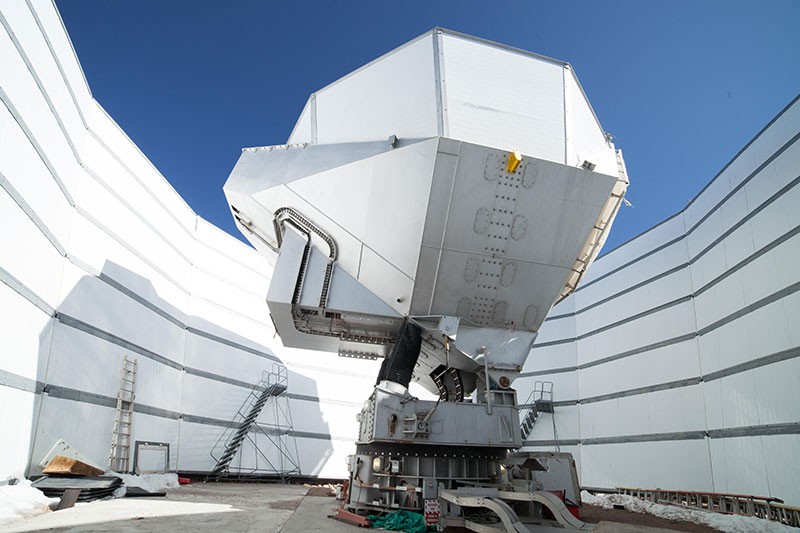
Atacama Cosmology Telescope in the Atacama Desert in the north of Chile.
Data from the Atacama Cosmology Telescope suggest the existence of two types of dark energy at the very start of the Universe.Credit: Giulio Ercolani/Alamy

Cosmologists have found signs that a second type of dark energy — the ubiquitous but enigmatic substance that is pushing the current Universe’s expansion to accelerate — might have existed in the first 300,000 years after the Big Bang.

Two separate studies — both posted on the arXiv preprint server in the past week1,2 — have detected a tentative first trace of this ‘early dark energy’ in data collected between 2013 and 2016 by the Atacama Cosmology Telescope (ACT) in Chile. If the findings are confirmed, they could help to solve a long-standing conundrum surrounding data about the early Universe, which seem to be incompatible with the rate of cosmic expansion measured today. But the data are preliminary and don’t show definitively whether this form of dark energy really existed.

Read More »
UNIVERSE

No Sign Of Planet Nine? Trail Runs Cold for Hypothetical World

Jonathan O’Callaghan

Nature | February 19, 2021

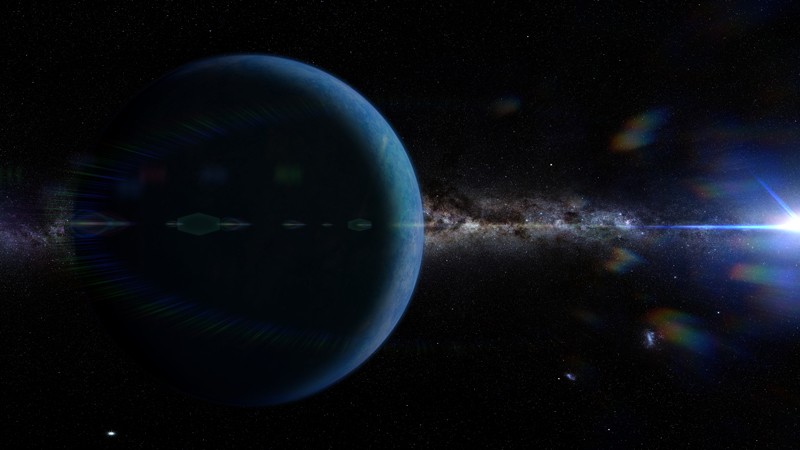
A blue planet seen in front of the Milky Way.
The hypothetical ninth planet (illustration). Credit: Shutterstock

Planet Nine is dead; long live Planet Nine? For some years, scientists have debated the existence of an unseen planet at least five times the mass of Earth in the outer reaches of the Solar System. Now, the hypothesis has been dealt a blow by a new analysis of distant, icy objects, which questions the evidence that they are under the gravitational pull of a huge planet.

The findings do not rule out the possibility of a ninth planet orbiting the Sun, and astronomers say more data will be needed to put the debate to rest.Read More »

DARK MATTER

The Search for Dark Matter Is Dramatically Expanding

Charlie Wood

Quanta Magazine | November 23, 2020

Infographic showing the ranges of possible masses of WIMPs, axions, ultralight dark matter, sub-GeV dark matter and primordial black holes, which are five different candidates for dark matter.
Dark matter could be made up of particles with a vast range of possible masses.

Ever since astronomers reached a consensus in the 1980s that most of the mass in the universe is invisible — that “dark matter” must glue galaxies together and gravitationally sculpt the cosmos as a whole — experimentalists have hunted for the nonluminous particles.

Read More »

UNIVERSE

Early Onset of Planet Formation Observed in a Nascent Star System

Patrick Sheehan

Nature | October 07, 2020

Illustration of glowing rings of gas and dust around a nascent star.

This artist’s impression shows an embryonic star that is less than 500,000 years old. The protostar, called IRS 63, is so young that its birth cloud of gas and dust is still collapsing to form the star and its protostellar disk. The series of rings and gaps could be signs of planetary formation (the rings in the actual system are very faint and are shown more prominently here, for clarity). The findings cast light on the earliest time at which planets can start to form.

Young stars are typically surrounded by rotating disks of gas and dust, called protoplanetary, or protostellar, disks. These structures are, crucially, the reservoirs of material that go on to form planets, but when the planet-forming process begins is a major open question. In a paper in Nature, Segura-Cox et al.1 cast light on this mystery by reporting a series of rings and gaps in a protostellar disk that is so young that its birth cloud is still collapsing to form the star and disk. Such features are frequently attributed to planets carving lanes through the disk. Given that this is perhaps the youngest disk observed to have such features, the findings help to set the timescale for the emergence of planets and place key constraints on theories of how planets assemble.

Read More »

SCIENCE 

Scientists Spot a Triple-star System Shredding its Planet-forming Disk in a Cosmic First

Chelsea Gohd

SPACE.COM | August 01, 2020

https://www.space.com/gw-orionis-triple-star-system-tears-apart-disk.html?utm_source=Nature+Briefing&utm_campaign=b19d1ddb27-briefing-dy-20200910&utm_medium=email&utm_term=0_c9dfd39373-b19d1ddb27-45531014&jwsource=cl

Groups of stars can tear their planet-forming disk to shreds, leaving behind warped, misaligned rings, scientists find in a breakthrough study.

Solar systems like ours generally form with their planets all orbiting in the same, flat plane. But, as an international team of scientists has found in a new study, this isn’t always the case. Read More »

UNIVERSE 

‘It’s Mindboggling!’: Astronomers Detect Most Powerful Black-hole Collision Yet

Davide Castelvecchi

Nature | September 02, 2020

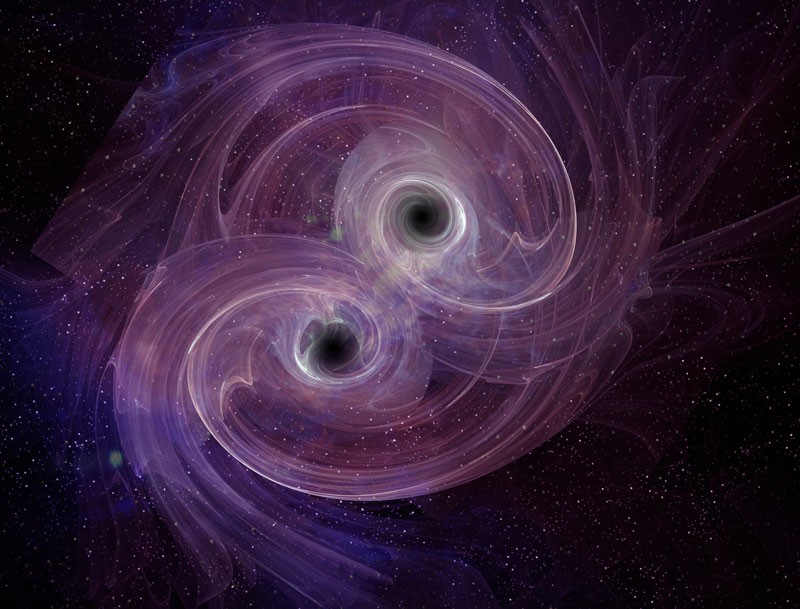
Artistic concept of two black holes circling each other before merging

An artist’s impression of two colliding black holes.Credit: Carol & Mike Werner/Visuals Unlimited, INC./Science Photo Library

Astronomers have detected the most powerful, most distant and most perplexing collision of black holes yet using gravitational waves. Of the two behemoths that fused when the Universe was half its current age, at least one — weighing 85 times as much as the Sun — has a mass that was thought to be too large to be involved in such an event. And the merger produced a black hole of nearly 150 solar masses, the researchers have estimated, putting it in a range where no black holes had ever been conclusively seen before.

Read More »

SCIENCE AND HISTORY

The History of the Universe in the Blink of an Eye

Shamini Bundell

Nature | August 14, 2020

The history of our Universe is written in the skies. Radio astronomers can detect ancient signals from the dawn of time as well as light from our nearest neighbours. Separating out these layers of time and space allows them to reconstruct the evolution of the Universe. This film reveals how thirteen billion years of history can be captured in a single moment.

doi: 10.1038/d41586-019-02459-x

Read More »

Here’s How the ‘Brightest’ Object in the Universe Formed

by Andrew Blain

The Wire | November 21, 2018

Active galaxies are some of the most luminous and impressive objects in the sky. They tend to be massive, distant and emit extraordinary amounts of energy as material falls into the supermassive black hole that lurks at their centre. Astronomers have recently discovered that some of them are also hidden from plain view by huge amounts of gas and smoke-like dust. But it is unclear how these rare objects form and feed.

Read More »

Is the universe a hologram?

ScienceDaily

At first glance, there is not the slightest doubt: to us, the universe looks three dimensional. But one of the most fruitful theories of theoretical physics in the last two decades is challenging this assumption. The “holographic principle” asserts that a mathematical description of the universe actually requires one fewer dimension than it seems. What we perceive as three dimensional may just be the image of two dimensional processes on a huge cosmic horizon.Read More »